
(To see other currencies, click on price)
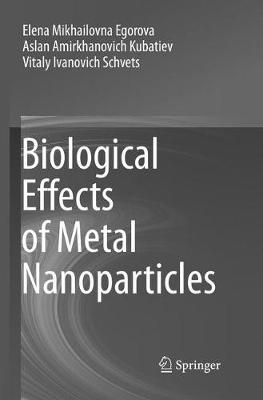
MORE ABOUT THIS BOOK
Main description:
This
book offers a comprehensive overview of recent studies conducted on the
biological effects of metal nanoparticles. It also provides a solid theoretical
foundation and various metal nanoparticle synthesis methods.
Part
I reviews the main chemical methods used for synthesizing metal nanoparticles
in a solution and describes original method of biochemical synthesis, as well
as some special procedures developed specifically for studying the biological
activity of nanoparticles.
Part
II analyzes current literature on the effects of metal nanoparticles observed
in microorganisms and addresses the influence of silver nanoparticles obtained
by biochemical synthesis on biological objects on various organization levels,
namely on microorganisms, acellular slim
mold, unicellular alga, plant seeds and
mammalian cells.
The
last section explains the central problems common in studies on the biological
effects of metal nanoparticles and outlines potential uses of this trend in
bio-nanotechnologies.
This
book is aimed at specialists, professors and students aspiring to expand their
knowledge about the biological activities of metal nanoparticles and
nanoparticle-containing materials.
Contents:
CONTENTSAbbreviations and designationsIntroduction
Part IPREPARATION AND CHARACTERIZATION OF METAL NANOPARTICLES IN SOLUTIONS
Chapter 1Methods of the nanoparticles preparation in solutions LI. Introductory remarks1.2. Principles used for the choice of methods1.3. Chemical synthesis with traditional reducing agents1.3.1.General considerations1.3.2.Synthesis in water solution1.3.3.Synthesis in the two-phase system and non-aqueous solutions1.3.4.Synthesis in reverse micelles1.4. Photo-and radiation-chemical synthesis1.5. Electrochemical synthesis1.6. Biological reduction in water solution1.7. Summary
Chapter 2Biochemical synthesis of metal nanoparticles2.1. Prerequisites of the method2.1.1.General information on the properties of flavonoids2.1.2.AOT/isooctane reverse micelles2.2. Cieneral scheme of the synthesis2.3. Peculiarities of the experimental procedure2.3.1.Preparation of the flavonoid micellar solution2.3.2.Extinction coefficient determination for the flavonoids in micellar solution2.4. Examples of the nanoparticles synthesis2.4.1. Silver nanoparticles2.4.2. Gold nanoparticles2.4.3. Copper nanoparticles
Chapter 3Development of the biochemical synthesis for practical applicationsDetermination of the extinction coefficient for Ag nanoparticles3.1.1. Extinction coefficient of the complex3.1.2. Extinction coefficient of the nanoparticles3.2. The effect of C Qr /C Ag relation on the formation rate and yield of silver nanoparticles3.3. Preparation of small nanoparticles with narrow size distributionChapter 4Preparation of metal nanoparticles in water solutions on the basis of biochemical synthesis4.1. Preparation of nanoparticles as water dispersions by their transfer from micellar solution4.2. Characteristics of silver and gold nanoparticles in water solution4.2.1.Silver nanoparticles4.2.2.Gold nanoparticles4.3. Synthesis of silver and copper nanoparticles in water solution with natural stabilizers4.3.1.Starch-stabilized Ag nanoparticles4.3.2.Cyclodextrin-stabilized Ag nanoparticles4.3.3.Starch-stabilized Cu nanoparticles4.3.4.Comparison with the data found in literature
Chapter 5Materials modified with metal nanoparticles5.1. Creation of liquid-phase materials with metal nanoparticles5.2. Solid materials with Ag and Cu nanoparticles
Part IIBIOLOGICAL EFFECTS OF METAL NANOPARTICLESGeneral information
Chapter 6The effect of metal nanoparticles on biological objects (analysisof the literature)6.1. Metal nanoparticles effects observed on microorganisms6.1.1. Antimicrobial activities of Ag nanoparticles<6.1.2. Antimicrobial activities of Cu, Au and metal oxides nanoparticles....6.2. On the mechanism of antimicrobial activities of metal nanoparticles6.3. Summary
Chapter 7Antimicrobial activity of nanoparticles stabilized by synthetic surface active substance7.1. Ag and Cu nanoparticles in liquid medium7.1.1.Varnish-paint materials with biocidal properties7.1.2.Water solutions of Ag nanoparticles7.2. Solid materials and polymer films with Ag nanoparticles
Chapter 8The effect of silver nanoparticles on some objects from the fungal and vegetable kingdoms8.1. Plasmodium of the acellular slime mold Physarum polycephalum8.2. Unicellular alga Chlorella vulgaris8.3. Plant seeds
Chapter 9The effect of silver nanoparticles on human cells in vitro and mammalians in vivo9.1. The effect of Ag nanoparticles on cells in vitro9.1.1.Toxicity of Ag nanoparticles for tumor cells. Stabilizationby AOT9.1.2.Toxicity of Ag nanoparticles for normal cells. Stabilizationby starch9.2. The effect of Ag nanoparticles on mammalian organism9.3. Inferences from the results of our studies
ConclusionReferences
PRODUCT DETAILS
Publisher: Springer (Springer International Publishing AG)
Publication date: May, 2018
Pages: 292
Weight: 4686g
Availability: Available
Subcategories: Biochemistry, Pharmacology