
(To see other currencies, click on price)
MORE ABOUT THIS BOOK
Main description:
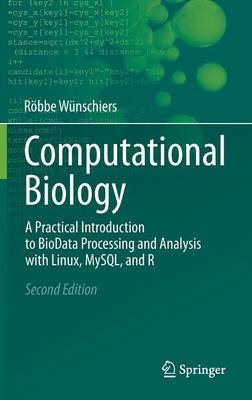
This greatly expanded 2nd edition provides a practical introduction to
- data processing with Linux tools and the programming languages AWK and Perl
- data management with the relational database system MySQL, and
- data analysis and visualization with the statistical computing environment R
for students and practitioners in the life sciences. Although written for beginners, experienced researchers in areas involving bioinformatics and computational biology may benefit from numerous tips and tricks that help to process, filter and format large datasets. Learning by doing is the basic concept of this book. Worked examples illustrate how to employ data processing and analysis techniques, e.g. for
- finding proteins potentially causing pathogenicity in bacteria,
- supporting the significance of BLAST with homology modeling, or
- detecting candidate proteins that may be redox-regulated, on the basis of their structure.
All the software tools and datasets used are freely available. One section is devoted to explaining setup and maintenance of Linux as an operating system independent virtual machine. The author's experiences and knowledge gained from working and teaching in both academia and industry constitute the foundation for this practical approach.
Feature:
Updated and expanded new edition
New, practical exercises suitable both for courses and self-teaching
Written by an experienced lecturer and researcher
Case studies, exercises with solutions and worked-out examples are included to demonstrate and practice
Not only beginners, but also more experienced bioinformaticists will be able to gather new insights
Shows how to efficiently extract, organize and visualize information from large datasets
Back cover:
This greatly expanded 2nd edition provides a practical introduction to
- data processing with Linux tools and the programming languages AWK and Perl
- data management with the relational database system MySQL, and
- data analysis and visualization with the statistical computing environment R
for students and practitioners in the life sciences. Although written for beginners, experienced researchers in areas involving bioinformatics and computational biology may benefit from numerous tips and tricks that help to process, filter and format large datasets. Learning by doing is the basic concept of this book. Worked examples illustrate how to employ data processing and analysis techniques, e.g. for
- finding proteins potentially causing pathogenicity in bacteria,
- supporting the significance of BLAST with homology modeling, or
- detecting candidate proteins that may be redox-regulated, on the basis of their structure.
All the software tools and datasets used are freely available. One section is devoted to explaining setup and maintenance of Linux as an operating system independent virtual machine. The author's experiences and knowledge gained from working and teaching in both academia and industry constitute the foundation for this practical approach.
Contents:
Part I Whetting Your Appetite.- 1 Introduction.- 2 Content of this Book.- Part II Computer & Operating Systems.- 3 Unix/Linux.- Part III Working with Linux.- 4 The First Touch.- 5 Working with Files.- 6 Remote Connections.- 7 Playing.- 8 Using the Shell.- 9 Installing BLAST+ and ClustalW.- 10 Shell Programming.- 11 Regular Expressions.- 12 Sed.- Part IV Programming.- 13 AWK.- 14 Perl.- 15 Other Programming Languages.- Part V Advanced Data Analysis.- 16 Relational Databases with MySQL.- 17 The Statistics Suite R.- Part VI Worked Examples.- 18 Genomic Analysis of the Pathogenicity Factors from E. coli Strain O157:H7 and EHEC Strain O104:H4.- 19 Limits of BLAST & Homology Modeling.- 20 Virtual Sequencing of pUC18c.- 21 Querying for Potential Redox-Regulated Enzymes.- Part VII Additional Material.- References.- A Supplementary Information.- Solutions.- Index.
PRODUCT DETAILS
Publisher: Springer (Springer Berlin Heidelberg)
Publication date: January, 2013
Pages: 493
Weight: 877g
Availability: Not available (reason unspecified)
Subcategories: Biochemistry
Publisher recommends
CUSTOMER REVIEWS
From the reviews of the second edition:
“This book aims to guide an astute pupil on the path to acquiring a practical familiarity with the UNIX command line. … I found the book entertainingly written and well edited--increasingly rare attributes in current books on computing. … The book is a spirited introduction to data processing on Unix, and will also be useful to driven data wranglers who are not necessarily in the biology field.” (A. Squassabia, Computing Reviews, November, 2013)
“This work will be valuable to new computational biology/bioinformatics students who want to learn programming. … Students can follow each chapter by working out the code on their own computers, and they can sharpen their programming skills by trying out the exercise at the end. … The book will be a good starting point for many newcomers who have no or little idea of programming as well as a concise reference guide for students and scientists. Summing Up: Highly recommended. All academic and professional audiences.” (V. Mathura, Choice, Vol. 51 (3), November, 2013)