
(To see other currencies, click on price)
MORE ABOUT THIS BOOK
Main description:
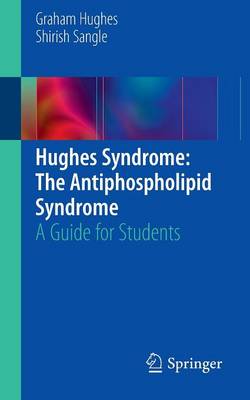
Hughes Syndrome: The Antiphospholipid Syndrome, A Guide for Students provides an in-depth analysis into the main effects of Hughes Syndrome.
In 1983, Dr Graham Hughes, and his team in London, described a syndrome and subsequently developed simple blood tests to diagnose the condition. This syndrome is characterised by thrombosis (both in limbs and internal organs), headaches, memory loss, strokes and, in pregnant women, placental clotting and recurrent miscarriage. The syndrome, now known worldwide as Hughes Syndrome, or the Antiphospholipid Syndrome, is common - being responsible for example, for up to 1 in 5 cases of young stroke and more importantly, it is treatable.
Hughes Syndrome: The Antiphospholipid Syndrome, A Guide for Students details the effects of Hughes Syndrome on the major organs, making it a valuable reference tool for students in training.
Contents:
History.- Clinical features.- Pregnancy & infertility.- Venous thrombosis.- Migraine & stroke.- Movement disorders & seizures.- Neuro psychiatric aspects.- Spinal cord, multiple sclerosis, peripheral nerves.- The Heart
The arteries.- Kidneys.- Skin.- The eye.- Ear, nose & throat.- Lungs.- Liver & gut.- Bones & joints.- Blood.- Catastrophic APS.- Diagnosis.- Treatment.- Aetiology - genetics vs. environment.- Links to other diseases.- The world map.
PRODUCT DETAILS
Publisher: Springer (Springer London Ltd)
Publication date: November, 2011
Pages: 119
Weight: 163g
Availability: Available
Subcategories: Diseases and Disorders, Rheumatology