
(To see other currencies, click on price)
MORE ABOUT THIS BOOK
Main description:
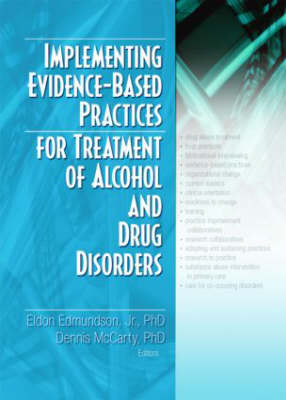
"Implementing Evidence-Based Practices for Treatment of Alcohol and Drug Disorders" provides managers and clinicians with results from Practice Improvement Collaboratives (PIC) that demonstrate how substance abuse treatment can be improved by increasing the exchange of knowledge between community-based service providers and the research community. The book examines improvement collaboratives and mentoring strategies for adopting and using evidence-based practices. Contributors address how to determine the best treatment processes to serve clients, how to deal with the hurdles faced in preparing and training counsellors, and how to affect the needed changes in agency activities. This unique professional resource responds to an Institute of Medicine report that found a substantial disconnect between research and practice in treatment for drug and alcohol dependence. Focusing on how to make the changes necessary to support the adoption and use of evidence-based practices, the book documents the activities of four sites to illustrate how investigators and treatment practitioners worked together to implement evidence-based practices. Contributors examine the development and early implementation of Practice Improvement Collaboratives, the investigator-provider-policymaker model, Motivational Enhancement Therapy, the use of Opinion Leaders in training, and targeted strategies that take into account the differences in clinician demographics and training. "Implementing Evidence-Based Practices for Treatment of Alcohol and Drug Disorders" is an essential tool for alcohol and drug counsellors, directors of alcohol and drug treatment clinics, and instructors in counsellor training and academic programs.
Contents:
Chapter 1 Practice Improvement Collaboratives: An Overview, Frances Cotter, Suzanne Bowler, Virginia Mulkern, Dennis McCarty; Chapter 2 A Study on the Effectiveness of a Brief Motivational Enhancement Therapy Training, Richard Ager, Stephanie Roahen-Harrison, Paul J. Toriello, Patricia Morse, Edward Morse, Linton Carney, Janet Rice, Patricia Kissinger; Chapter 3 Substance Abuse Counseling: What Is Treatment as Usual?, Michele J. Eliason, Stephan Arndt, Arthur Schut; Chapter 4 Use of Opinion Leaders and Intensive Training to Implement Evidence-Based Co-Occurring Disorders Treatment in the Community, Roger H. Peters, Kathleen A. Moore, Holly A. Hills, M. Scott Young, James B. LeVasseur, Alexander R. Rich, W. Michael Hunt, Thomas W. Valente; Chapter 5 The Relationship Between Addictions Counselors' Clinical Orientations and Their Readiness to Change Counseling Techniques, Paul J. Toriello, Stephanie Roahen-Harrison, Janet Rice, Richard Ager, Edward V. Morse, Patricia Morse, Linton Carney, Patricia J. Kissinger; Chapter 6 Barriers to Implementation of an Evidence-Based Practice: The Example of Methadone Maintenance, Jodie A. Trafton, Keith Humphreys, Daniel Kivlahan, Mark Willenbring;
PRODUCT DETAILS
Publisher: Taylor & Francis (Routledge Member of the Taylor and Francis Group)
Publication date: May, 2006
Pages: 115
Weight: 60g
Availability: Available
Subcategories: Addictions and Therapy, Psychotherapy