
(To see other currencies, click on price)
MORE ABOUT THIS BOOK
Main description:
Neurovascular diseases and conditions, and their associated risk factors, represent a significant cause of cognitive disability in the United States and throughout the world. In the USA alone there are 750,000 new strokes each year, representing the number one cause of disability in the country. Hypertension, found in approximately 50 million Americans, has been shown to be associated with alterations of cognitive function, even in the absence of stroke and dementia. Recent studies of neurovascular disease have now revealed that neuropsychological function may be a more sensitive measure of brain integrity than coordination, motor or sensory function and correlates will with functional outcome measures.
Neurovascular Neuropsychology focuses on focal and diffuse neurovascular disease in addition to systemic conditions in which cognition and behavior have been uniquely associated with different pathologic states. With an increasing number of patients being treated by healthcare professionals, Neurovascular Neuropsychology will prove to be a strong reference to consult in regards to neuropsychological syndromes.
Feature:
Only recent text focusing on the cognitive syndromes associated with this range of neurovascular diseases and systemic causes of vascular-related cognitive changes
Satisfies the need of healthcare professionals, including psychologists, who need a reference on the nature of the neurophysical syndromes and the associated regions of brain injury
An international group of contributors addresses neuropsychological functions as an aspect of primary and secondary outcome measures
Back cover:
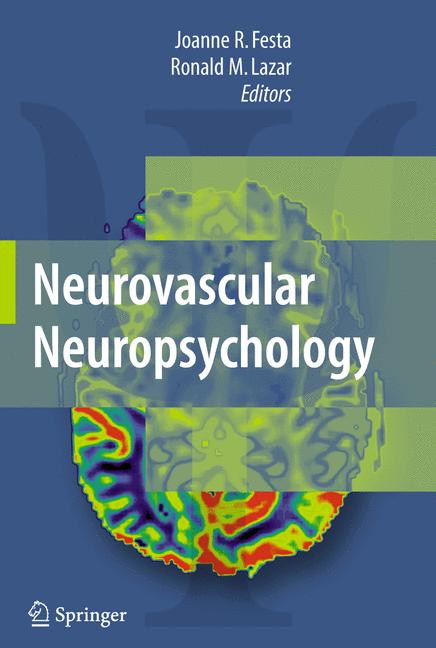
Neurovascular Neuropsychology
Edited by Joanne R. Festa and Ronald M. Lazar
Columbia University College of Physicians and Surgeons, New York
Neurovascular Neuropsychology offers a firm foundation for an emerging neuropsychological subspecialty that focuses on how cognition and behavior are affected by focal and diffuse cerebrovascular disease and systemic conditions. When cognitive impairment is caused by disruptions in blood flow and oxygenation, the presence of inflammation and immune factors, or the co-existence of cardiovascular risk factors, behavior can provide subtle but definite indicators of disease progression or therapeutic progress. This forward-looking volume examines intricate, causal links between brain function, vascular disorders and hemodynamic integrity in adults for a more nuanced understanding of neurovascular cognitive syndromes, their etiology, treatment, and recovery.
Chapter authors present the latest findings on neurocognitive deficits that emerge in diseases and disorders throughout the neurovascular system:
- Vascular malformations, aneurysms, and subarachnoid hemorrhage
- Ischemic and hemorrhagic stroke
- Cardiac arrest, heart failure, surgery, and transplantation
- Carotid artery disease
- Diabetes and hypertension
- Vascular cognitive impairment and dementia
- Pulmonary disease
- Systemic vascular disease
- CADASIL and MELAS
- Mood disorders
- Plus comprehensive reviews and insightful analyses of current modes of assessment and treatment, including functional MRI, pharmacology, and rehabilitation strategies.
The body of knowledge presented in Neurovascular Neuropsychology will add a new dimension to decision-making in the clinical and research efforts of psychologists (both clinical and neuropsychologists), physicians (neurologists, neurosurgeons, vascular surgeons, cardiologists, physiatrists), and rehabilitation specialists such as speech-language pathologists and occupational therapists.
Contents:
Historical Perspective.- Neurovascular Geography and Mapping the Consequences of Its Injury.- Ischemic and Intracerebral Hemorragic Stroke.- Cerebral Aneurysms and Subarachnoid Hemorrhage.- Neuropsychological Effects of Brain Arteriovenous Malformations.- Vascular Cognitive Impairment.- Vascular Dementia.- Cerebral Autosomal Dominant Arteriopathy with Subcortical Infarcts and Leukoencephalopathy (CADASIL) and Mitochondrial Encephalomyopathy Lactic Acidosis and Stroke-like Episodes (MELAS).- Carotid Artery Occlusion and Stenosis.- Cardiac Arrest.- Congestive Heart Failure/Heart Transplant.- Cognition After Cardiac Surgery.- Pulmonary Disease and Lung Transplantation.- Diabetes and Hypertension.- Neurovascular Consequences of Systemic Disease – Collagen Vascular Disease.- Neurovascular Disease and Mood Disorders.- Functional Imaging in Stroke Recovery.- Pharmacological Treatment for Cognitive Disorders of Neurovascular Origin.- Neuropsychological Rehabilitation.
PRODUCT DETAILS
Publisher: Springer (Springer New York)
Publication date: May, 2009
Pages: 332
Availability: Not available (reason unspecified)
Subcategories: Cardiovascular Medicine, Neurology, Neurosurgery
Publisher recommends
CUSTOMER REVIEWS
From the reviews: “Neurovascular Neuropsychology presents an extremely lucid, state-of-the art, detailed overview of an emerging interdisciplinary specialty area that is rapidly increasing our clinical and theoretical understanding of the role of cerebral circulation in health and disease states. This volume presents a wealth of information that is centrally important to neurologists, psychiatrists, radiologists, physiatrists, and transplant surgeons as well as to clinical and experimental neuropsychologists … . It should be read by a very wide variety of professionals who have an interest in brain–behavior relationships.” (James A. Moses Jr., PsycCRITIQUES, Vol. 55 (12), March, 2010) "Festa and Lazar’s work is a timely effort to continue that effort to broaden and deepen our perspective on vascular disease as related to neuropsychological functioning....written by a remarkably international list of contributors with expertise at many levels in the field of vascular disease... the chapters are clearly and concisely written and provide an excellent, broad-based introduction for each topic.... One of the strengths of this text and the presented reviews is that research to date is critically presented, with discussion of the problems in methodology, an awareness of the limited conclusions that are afforded in comparing the results of various studies, and clear directions and recommendations for future research. (Richard C. Delaney , Ph.D. ABPP-CN , Journal of the International Neuropsychological Society, 2010)