
(To see other currencies, click on price)
MORE ABOUT THIS BOOK
Main description:
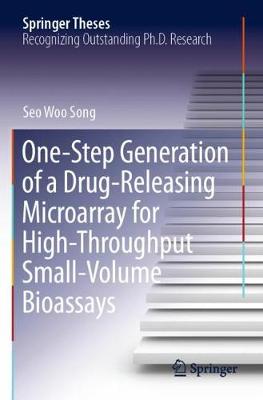
This thesis demonstrates a technology that enables pipetting-free high-throughput screening (HTS) on a miniaturized platform, eliminating the need for thousands of one-by-one pipetting and conventional liquid handling systems. This platform enhances accessibility to HTS and enables HTS to be used in small-to-medium scale laboratories. In addition, it allows large-scale combinatorial screening with a small number of valuable cells, such as patients' primary cancer cells. This technique will have a high impact for widespread use of HTS in the era of personalized medicine.
In this thesis, the author firstly describes the need and concept of 'partipetting' for pipetting-free HTS platform. It is realized by the one-step pipetting and self-assembly of encoded drug-laden microparticles (DLPs) on the microwells. Next, the technical implementations required for the platform demonstration are described. It includes preparation of encoded DLPs, plastic chip fabrication, and realization of automated system. Lastly, screening of sequential drug combinations using this platform is demonstrated. This shows the potential of the proposed technology for various applications.
Contents:
Abstract
Table of Contents
List of Tables
List of Figures
Chapter 1. Introduction
1.1. High-Throughput Small-Volume Bioassays
1.1.1. Miniaturization Trends in Biochemical Screening Platform
1.1.2. Clinical Value of the Small-Volume HTS Platform
1.1.3. Lab-on-a-Chip Based HTS Platforms
1.2. Developmental Goal for the 'Pipetting-Free' HTS Platforms
1.2.1. Difficulties in Automation of Liquid Handling System
1.2.2. Previous Researches for 'Pipetting-Free' HTS Platforms from Other Groups
1.3. Main Concept: One-Step Generation of a Drug-Releasing Microarray-on-a-Chip by Self-Assembly of Drug-Laden Microparticles (DLPs)
1.3.1. Previous Works of Partipetting from Our Group and Their Limitations
1.3.2. My Works in This Dissertation
Chapter 2. System Development
2.1. Sealing-Film Assisted Seeding Method for Saving Cell Consumptions
2.2. Chip and Jig Development
2.2.1. Polystyrene-Poly(dimethylsiloxane) (PS-PDMS) hybrid Chip for Precise Alignment and Sealing
2.3. Preparation of DLPs Library
2.3.1. Microparticles as Drug Carriers and Requirements for Drug Loading
2.3.2. Strategies to Increase the Absorbing Amount of Drugs into Hydrogel Microparticles
2.3.3. Mixing Drug Solution with Prepolymer to Fabricate Microparticles
2.3.4. Drug Loading into Prefabricated Microparticles by Freeze-Drying
2.4. Decoding Microparticles
2.4.1. Design of Graphical Codes on the Microparticles
2.4.2. Decoding by Neural-Network-Based Recognition of Coding Components
2.4.3. Neural-Network-Based Decoding from an Image of a Whole Microparticle
2.5. Statistical Analysis for Duplications
2.5.1. Binomial Distribution Model for Random Assembly of Microparticles
2.5.2. Monte-Carlo Simulation for Statistical Analysis
Chapter 3. Application: Screening of Sequential Drug Combinations
3.1. Therapeutic Benefit of Sequential Drug Combination Based on Rewiring of Intracellular Pathways
3.2. Screening of Sequential Drug Combination Using a Partipetting Platform
3.3. Proof-of-Concept: Sequential Combinatorial Cell Staining Assay by Replacement of the Drug Chip
3.4. Screening of Sequential Combinatorial Drugs with EGFR Inhibitor Followed by Genotoxin against Triple Negative Breast Cancer (TNBC)
Chapter 4. Conclusion and Discussion
Bibliography
PRODUCT DETAILS
Publisher: Springer (Springer Verlag, Singapore)
Publication date: August, 2020
Pages: 52
Weight: 454g
Availability: Available
Subcategories: Biomedical Engineering, Genetics