
(To see other currencies, click on price)
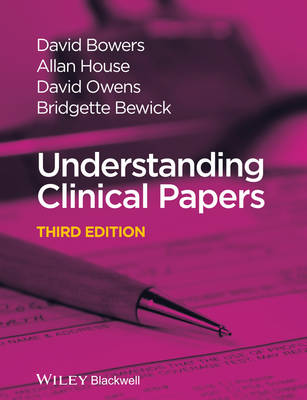
MORE ABOUT THIS BOOK
Main description:
Do you want to keep up with clinical research but find that you are confused by the way
it is presented in the journals?
The answer is Understanding Clinical Papers.
Understanding Clinical Papers, Third Edition explains important research–related topics using actual
papers from clinical journals to illustrate how to understand and evaluate published research. The
authors use an imaginative pictorial approach for an enjoyable and informative read.
This new edition has been fully revised and expanded to include several new chapters on
qualitative and mixed methods research, as well as new quantitative material. With updated
examples drawn from current research, Understanding Clinical Papers remains a valuable resource
for all healthcare professionals.
Praise for previous editions
What makes this book unique is that each point presented is illustrated with excerpts from actual
papers, often three or four per chapter this is a very effective teaching device.
Journal of the American Medical Association
This book should be an essential addition to the personal libraries of all health care workers who
need to use articles in journals. In these days of evidence–based medicine, this should apply to all
physicians, nurses and other health professionals. Oncology
The writing style is amazingly clear and does not require formal course work in biostatistics or
epidemiology . This friendly informal paperback book is a bargain at the price and should have
wide use. We strongly recommend it for beginners and for easy entry into a complex domain
and to experts who we think will enjoy it and who will find it useful as they teach, advise and help
others. Quality in Health Care
The great strength of this book lies in the lively and accessible way in which it is written, making
it particularly appealing to its target audience of practitioners and clinicians. Dealing with an
already well–covered topic which can be dry and unpalatable, the authors manage to present their
material in a colourful and interesting way. The language is clear and readable. It is well–structured,
logically mirroring the sequence of good quality papers. The examples from studies are well
chosen, interesting and at times entertaining in themselves. References are informative and help to
contextualise the information. This is a most useful book which I would recommend in particular for
students of all disciplines and practitioners involved in research activity.
Accident & Emergency Nursing
In summary, this book provides a great overview of how to read clinical papers in an informed way
it provides accessible and simple skills to assess research. Journal of Substance Use
Back cover:
Do you want to keep up with clinical research but find that you are confused by the way
it is presented in the journals?
The answer is Understanding Clinical Papers.
Understanding Clinical Papers, Third Edition explains important research–related topics using actual
papers from clinical journals to illustrate how to understand and evaluate published research. The
authors use an imaginative pictorial approach for an enjoyable and informative read.
This new edition has been fully revised and expanded to include several new chapters on
qualitative and mixed methods research, as well as new quantitative material. With updated
examples drawn from current research, Understanding Clinical Papers remains a valuable resource
for all healthcare professionals.
Praise for previous editions
What makes this book unique is that each point presented is illustrated with excerpts from actual
papers, often three or four per chapter this is a very effective teaching device.
Journal of the American Medical Association
This book should be an essential addition to the personal libraries of all health care workers who
need to use articles in journals. In these days of evidence–based medicine, this should apply to all
physicians, nurses and other health professionals. Oncology
The writing style is amazingly clear and does not require formal course work in biostatistics or
epidemiology . This friendly informal paperback book is a bargain at the price and should have
wide use. We strongly recommend it for beginners and for easy entry into a complex domain
and to experts who we think will enjoy it and who will find it useful as they teach, advise and help
others. Quality in Health Care
The great strength of this book lies in the lively and accessible way in which it is written, making
it particularly appealing to its target audience of practitioners and clinicians. Dealing with an
already well–covered topic which can be dry and unpalatable, the authors manage to present their
material in a colourful and interesting way. The language is clear and readable. It is well–structured,
logically mirroring the sequence of good quality papers. The examples from studies are well
chosen, interesting and at times entertaining in themselves. References are informative and help to
contextualise the information. This is a most useful book which I would recommend in particular for
students of all disciplines and practitioners involved in research activity.
Accident & Emergency Nursing
In summary, this book provides a great overview of how to read clinical papers in an informed way
it provides accessible and simple skills to assess research. Journal of Substance Use
Contents:
Preface to the First Edition vii
Preface to the Third Edition ix
PART I SETTING THE SCENE: WHO DID WHAT, AND WHY 1
1 Some Preliminaries 3
2 The Abstract and Introduction 7
3 The Aims and Objectives 14
PART II DESIGN MATTERS: WHAT TYPE OF STUDY IS IT? 21
4 Descriptive Studies: Qualitative 23
5 Descriptive Studies: Quantitative 29
6 Analytic Studies 35
7 Intervention Studies 42
8 Mixed Methods Research 50
PART III THE CAST: FINDING OUT ABOUT THE SUBJECTS OF THE RESEARCH 53
9 The Research Setting 55
10 Populations and Samples in Quantitative Research 59
11 The Sample in Qualitative Research 63
12 Identifying and Defining Cases 67
13 Controls and Comparisons 70
PART IV ESTABLISHING THE FACTS: STARTING WITH BASIC OBSERVATIONS 75
14 Identifying the Characteristics of Quantitative Data 77
15 Summarising the Characteristics of Quantitative Data 84
16 Identifying and Summarising the Characteristics of Qualitative Data 90
17 Measuring the Characteristics of Participants: Quantitative 93
18 Measuring the Characteristics of Participants: Qualitative 99
19 Measuring the Characteristics of Measures 102
20 Measurement Scales 106
21 Exploring and Explaining: Topic Guides 118
PART V ESTABLISHING MORE OF THE FACTS: SOME COMMON WAYS OF DESCRIBING RESULTS 121
22 Fractions, Proportions, and Rates 123
23 Risks and Odds 125
24 Ratios of Risks and Odds 128
PART VI ANALYSING THE DATA: ESTIMATION AND HYPOTHESIS TESTING 135
25 Confidence Intervals for Means, Proportions, and Medians 137
26 Confidence Intervals for Ratios 143
27 Testing Hypotheses the p–Value 147
PART VII ANALYSING THE DATA: MULTIVARIABLE METHODS 161
28 Measuring Association 163
29 Measuring Agreement 170
30 Linear Regression 175
31 Logistic Regression 185
32 Measuring Survival 190
33 Systematic Review and Meta–Analysis 196
34 Analysing Qualitative Data 206
35 Results in Text and Tables 211
36 Results in Pictures 219
37 The Discussion and Conclusions 227
References 231
Index 239
PRODUCT DETAILS
Publisher: John Wiley & Sons Ltd (Wiley–Blackwell)
Publication date: November, 2013
Pages: 264
Weight: 570g
Availability: Not available (reason unspecified)
Subcategories: Diseases and Disorders, General Issues